The Fabric of Reality, chapter 11
Time: the first quantum concept
Time has a reputation for mystery that distance never acquired. David Deutsch traces every part of that mystery to one idea, the flow of time, and argues that the idea makes no sense even on its own terms.
The chapter's diagrams had to stand still on the page. Here every one of them moves, and most respond to you. Work through them in order: each figure sets up the next.
1. The flow of time
Common sense pictures time as a line of fixed moments with one special point, the present, travelling along it towards the future. Whatever lies ahead of the point is future; whatever lies behind is past. The picture is so deeply rooted that grammarians use it to explain English tenses: Deutsch takes his first figure from Randolph Quirk's Comprehensive Grammar of the English Language.
There is a second version. Shakespeare, in Sonnet 60, keeps the present still and has the minutes stream past it towards their end. Either way, something moves.

2. Snapshots
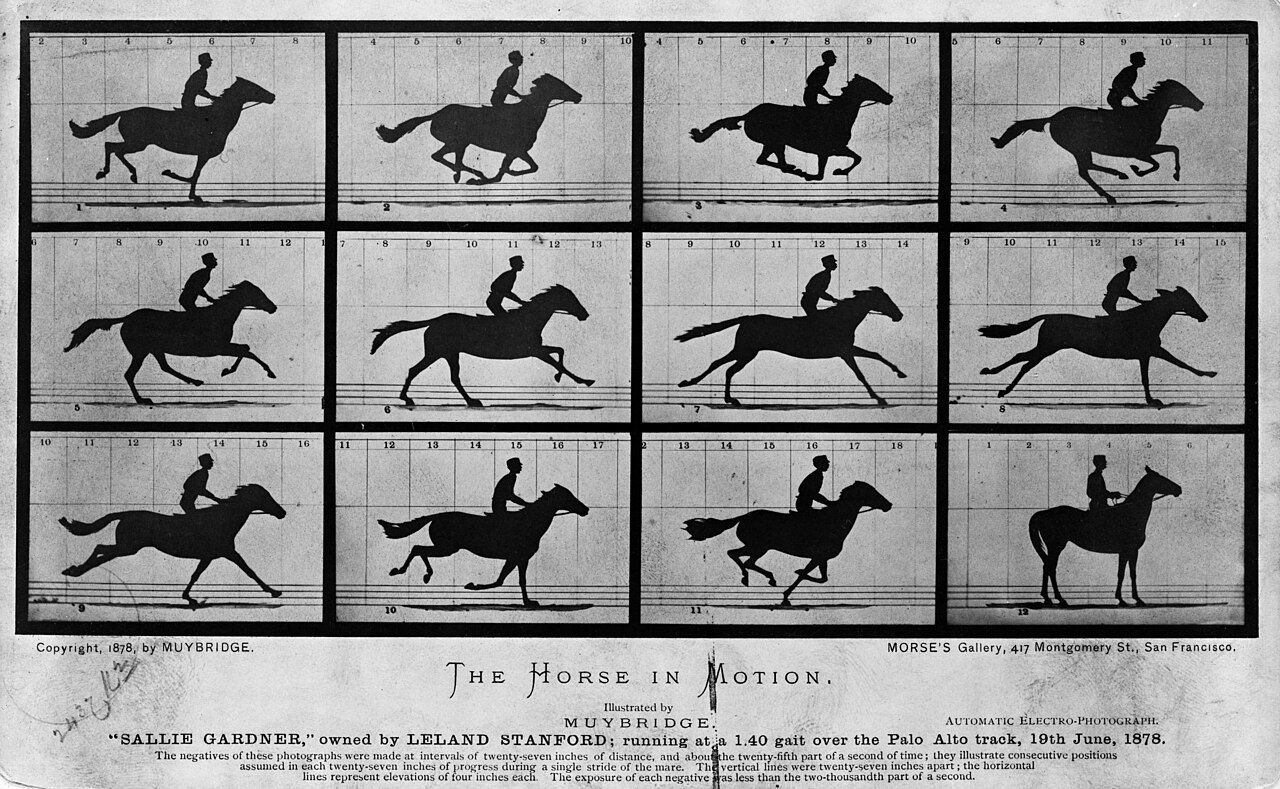
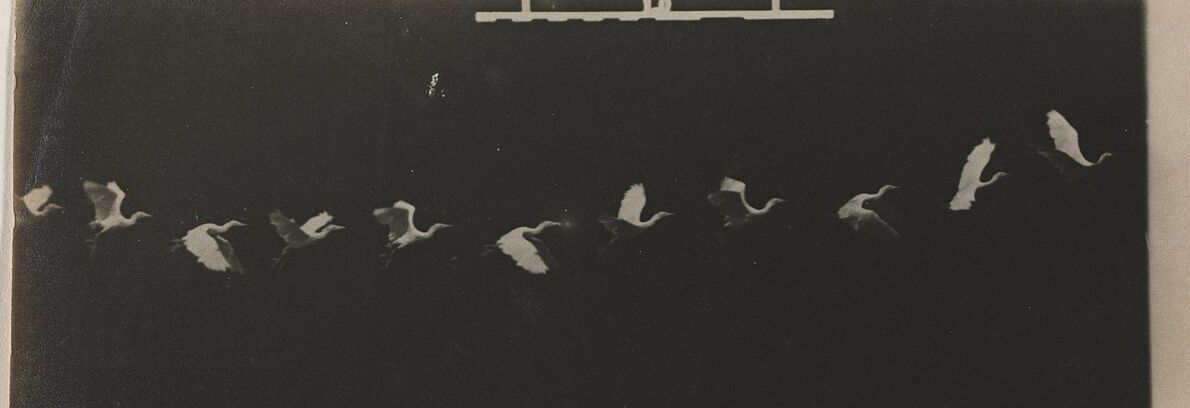
What does it mean to call time a line? A line is a sequence of points; a moving object, by the same token, is a sequence of motionless versions of itself, one per moment. Stack the versions of a rotating arrow side by side and the motion is all there, laid out at once.
On the common-sense theory, change happens when the present lights up these snapshots one after another, the way a projector turns a strip of still frames into a film. No single frame ever changes. Each simply takes its turn at being now.
Deutsch's verdict on this theory is blunt. Grammarians record how we talk, and they are right that this is our theory of time. It is also nonsense: not merely false, but incoherent.
3. Every moment is now
Look at what the picture shows. The arrow's motion is drawn properly, as a sequence of snapshots. The present's motion is not. It appears in one snapshot only, at one moment, and so the picture actually shows a present that springs into being at a single moment and vanishes, never reaching any other. Labelling it "moving" does not make it move.
To draw a moving present honestly, we must give it snapshots too, one for each moment, each showing where now is at that moment. And where is that? Obviously, at each moment, now is that very moment. At midnight it points at the midnight snapshot; at one o'clock, at the one o'clock snapshot.
Once every moment carries its own marker, the markers distinguish nothing and can go. The motion of the arrow is untouched. What remains is a sequence of unchanging moments with no flow at all.
"Now" turns out to work exactly like "here". Every position is here to someone standing at it, and none is objectively more here than another. Every moment is now to the version of you living through it, and none is objectively more now than another.
Nor does consciousness travel through time, carrying the present along with it. Every version of you, at every waking moment, is conscious and is in its own present. What you actually experience is the difference between your present perceptions and your present memories of earlier ones. You read that difference, correctly, as evidence that the world changes, and incorrectly, as evidence that something is moving through time.
4. The regress
Ask how fast the present moves, or what it would be like if it stopped for a day and then raced ahead at ten times its usual speed. The questions have no answers, because motion is change of position over time, and the line of moments already is time. For the present to move along it, there would have to be a second, exterior time against which to measure the motion.

The sequence of moments is an exceptional object. It does not sit inside the framework of time: it is the framework. Any accurate picture of it must therefore be static, which is exactly what makes such pictures hard to take in. To read one, your attention travels across the page, and it is easy to mistake that genuine motion of your eyes for an impossible motion of something through the moments.
Common sense wants two things at once. When we date an event, saying that Faraday discovered electromagnetic induction in 1831, we treat history as a fixed sheaf of moments and pick out some of them; no flow is involved, any more than a "flow of distance" is involved in saying where something happened. When we explain an event, saying that Faraday's discovery led to power stations, we picture its effects sweeping forward through the decades. We get away with it by never using both ideas in the same breath. Only when we think about time itself do they collide.
5. Spacetime
Physics took the coherent half. Newton wrote that time flows, but none of his equations, nor any physical theory since, makes any use of a flow. Strip it out and Newtonian time looks like figure 11.3, except that the moments form a continuum: infinitely many, infinitely thin snapshots, each one the whole of space at an instant. Glue them face to face and you have a single unchanging block holding everything that ever happens. That block is spacetime.
In Newton's physics this four-dimensional picture is optional. In Einstein's it is compulsory. Observers moving at different speeds disagree about which events are simultaneous, so they slice the block into moments at different angles. Yet each observer, stacking their own slices, builds the identical block. The moments are a point of view; the block is the reality. Within it nothing moves. Motion is just a difference between the contents of one slice and the next.
6. Shuffle the snapshots
Imagine standing, impossibly, outside spacetime. Cut it into snapshots, shuffle them, and glue them back in a new order. From outside the result would look grotesque: objects vanishing and reappearing, the laws of physics broken. But the people inside would notice nothing. Every snapshot still contains exactly the same perceptions, memories and records, including scientific papers describing the original order.
So the order of the moments is not imposed from outside. It is written into the snapshots themselves. Given any one snapshot and the laws of physics, you could work out all the others, their order, and where the first one fits. Each snapshot carries a time stamp in its own contents: a reading on some natural clock, whether an actual clock on a wall or the chemical make-up of the Sun.
7. The price: no causes
Spacetime is coherent, but it exacts a price. In it, the future is as fixed as the past. A moment cannot be "open" and later become settled, because moments do not change. Your deliberation over a choice sits at its own place in the block, already finished, along with its outcome.
Worse, cause and effect go too. Spacetime physics is deterministic: the laws let you calculate any moment from any other. But predictability is not causation. Fit together a jigsaw puzzle and one piece's position predicts every other's. Whether any piece caused another to be where it is depends on how the puzzle got there. If it was stamped out in one stroke, nothing caused anything. And in spacetime, moments cannot have been laid down one after another, since that would be the flow of time again.
Causation also needs variants. To say Faraday's discovery helped cause modern technology is to say that if he had died in 1830, technology would have been delayed. In spacetime there is no such event as Faraday dying in 1830, and no fact about its aftermath. We could imagine one, but we could imagine any aftermath we liked. Statements of this "if it had been otherwise" kind, which logicians call counterfactual conditionals, have no meaning in spacetime physics. Their long-standing air of paradox comes not from logic, Deutsch argues, but from false physics.
8. The multiverse
Physical reality is not a spacetime. It is the multiverse, and as a first approximation, a vast collection of spacetimes interacting slightly with one another. That alone rescues causation. There really are universes in which Faraday died in 1830, in definite proportions, and it is an objective fact whether technology was delayed in most of them. X causes Y when both happen in our universe and, in most variants where X does not happen, Y does not either.
If the multiverse really were a neat stack of spacetimes, time would be unchanged: a sequence of moments, each moment now a "super-snapshot" containing many universes. But quantum physics does not slice reality that way. Nothing determines which snapshot in another universe happens "at the same moment" as one in ours, because that would require a framework of time outside the multiverse, and there is none. So there is no fundamental line between snapshots of other times and snapshots of other universes. Deutsch puts it in one sentence: "Other times are just special cases of other universes."
The snapshots we call other times are simply the ones most tightly linked to ours by the laws of physics, and so the ones our own snapshot holds the most evidence about. We found them thousands of years before we found the rest of the multiverse, and grew past and future tenses to talk about them. For the others, we grew "if" and the subjunctive, without knowing what they referred to.
9. The spinning coin
Toss a coin, and look at the small region of the multiverse where it happens. Each point in the next figure stands for one snapshot. Snapshots with the same clock reading sit in the same vertical column, and readings increase to the right. Identical snapshots share a shade.
At the earliest readings every copy of you sees the coin spinning. Later, half the copies see heads and half see tails. In between, some copies see a coin still moving but already bound to land one way. Asking which half you will end up in has no answer, any more than asking which of your identical copies is really you. For practical purposes that is a fifty-fifty probability, yet the multiverse as a whole is completely determined.
The determinism runs backwards too, but only for the whole. The combined heads and tails snapshots fix the earlier spinning state; no single heads snapshot does. So any one later copy of you has lost the information needed to work out the past, while the earlier copy could have predicted the future.

10. Not every line is a history
Any horizontal line across the coin diagram passes through snapshots in order of rising clock readings. It is tempting to call each such line a spacetime, and the whole diagram a stack of them. Drag the line and read off the story it tells.
The point is that snapshots cannot be glued together however we please, only as the laws of physics relate them. In the multiverse there are far too many snapshots for clock readings alone to place them. What makes a history is the intricate pattern of which snapshots determine which others.
In some regions of the multiverse the snapshots of an object do fall into long chains, each link fixing all the rest to a good approximation. Successive states of the solar system are the standard example. There, classical physics works well, the multiverse does look like a stack of spacetimes, and time behaves like a sequence of moments. Every experiment so far lies inside that approximation.
11. Where sequence breaks down
Theory says the approximation must fail badly in three places. Near the Big Bang, snapshots stand in no particular order; time becomes sequential only somewhat later, around the Planck time of 10−43 seconds on the classical reckoning. Similar breakdowns are expected inside black holes and at any final Big Crunch. And at the very smallest scales, quantum effects are thought to warp spacetime into tiny closed loops of time.
That also dissolves an old puzzle. What happened before the Big Bang? Nothing: there are no moments there. The question only seems pressing if we imagine time starting up, as though it had been waiting. Time never starts or stops, because it never moves.
12. In short
In the multiverse, common-sense causation makes perfect sense. X causes Y if, given the snapshots with X, the laws fix the existence of snapshots with Y, and the variants without X fix only variants without Y. Nothing in that definition forces causes to come first. In our region they do, because the number of distinct kinds of snapshot keeps growing as clock readings rise: the multiverse face of the second law of thermodynamics. A settling coin turns one group of identical "predictably heads" snapshots into a vast spread of microscopically different "heads" ones, which is why the earlier snapshots cause the later ones and not the reverse.
The open future survives too, relative to each observer. Before the toss, both outcomes are possible from your point of view, though both are actual. Afterwards each copy of you remembers just one. The outcome has become single and fixed for every copy, while the multiverse stays as two-valued as ever.
- Time does not flow, and it is not a sequence of moments either.
- Every moment is "now" to those in it; none is objectively privileged.
- Spacetime fixed the incoherence of common sense, but at the cost of causes, choices and the open future.
- The multiverse gives them back. Causes and effects, an open future and a fixed past are all real, relative to observers.
- Other times are a special case of other universes. Time was a quantum concept all along.
Where next
Figures redrawn and animated after David Deutsch, The Fabric of Reality (Penguin, 1997), chapter 11. Text is a summary in our own words.