Ulm, Bern, Berlin and Princeton, 1879–1955
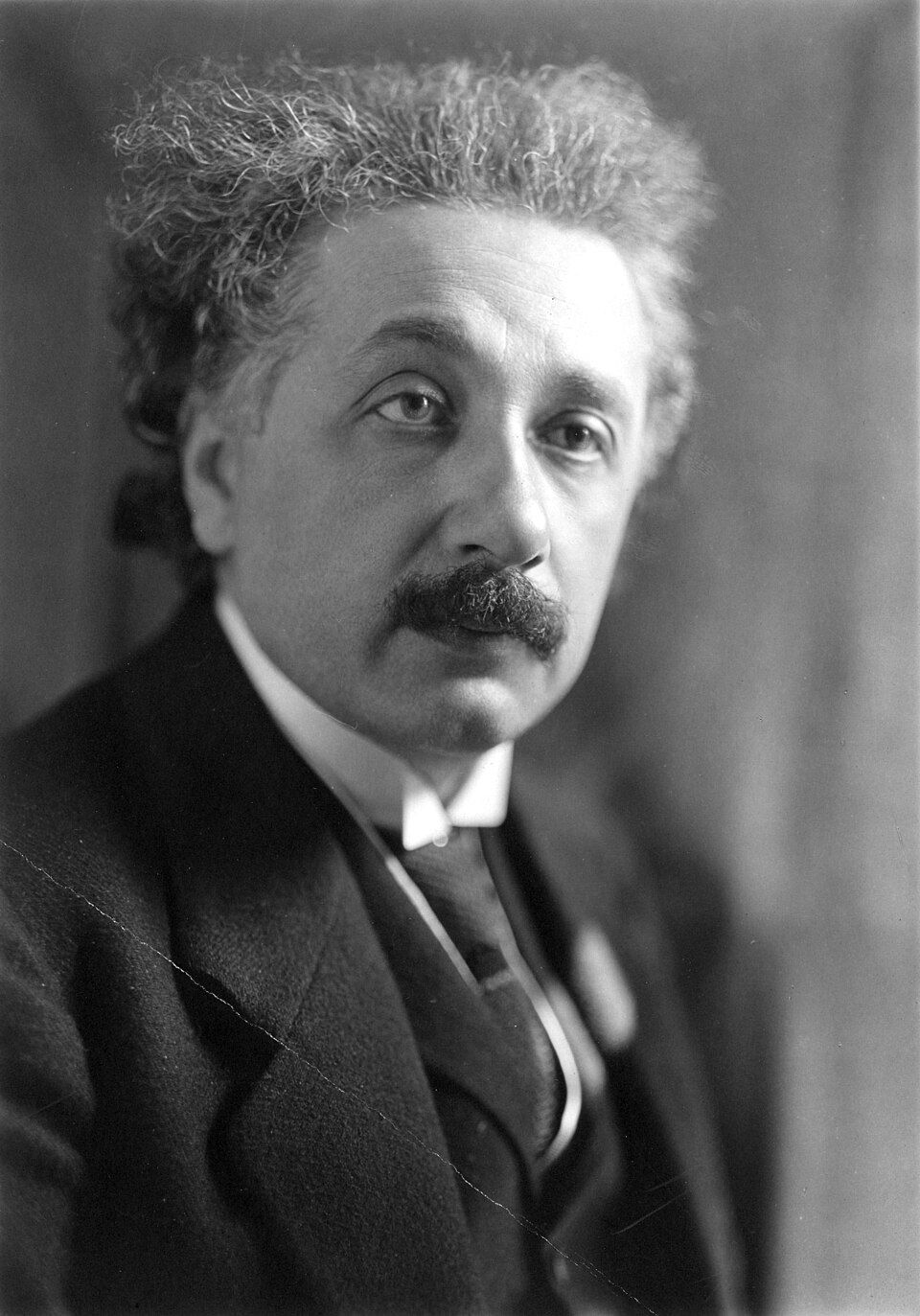
Albert Einstein
Time is what clocks measure, and clocks in different states of motion disagree. There is no universal now. Past, present and future, Einstein came to think, are distinctions that physics does not recognise.
The view
In 1905, while working at the patent office in Bern, Einstein published the special theory of relativity. Its first move concerned time. To say that two distant events happen at the same moment, we must say how we would check, and checking means sending signals. Once the speed of light is taken to be the same for every observer, observers in relative motion disagree about which distant events are simultaneous. Neither is wrong.
Hermann Minkowski showed in 1908 that the theory is most naturally written in a four-dimensional spacetime, and Einstein's general theory of relativity (1915) made spacetime itself dynamic: clocks run at different rates in different gravitational fields. Time had become part of the geometry of the world.
The argument
Simultaneity is relative. Picture three lamps flashing along a line, simultaneously for you. A traveller moving along the line, applying the same procedure, finds that one flashed first. Neither ordering is privileged. Only the spacetime itself, with its fixed light cones, is the same for everyone.
So there is no universal now. If there were an objective present sweeping through the universe, some observers would be right about simultaneity and others wrong. Relativity gives no way to choose. This is why many philosophers take relativity to support the block universe: all events are laid out in spacetime, none of them privileged as present.
The now troubled him. The philosopher Rudolf Carnap recalled that Einstein once told him the problem of the Now worried him seriously. Our experience of the present was something essential, and yet physics had no place for it.
A consolation. When his lifelong friend Michele Besso died in March 1955, a few weeks before his own death, Einstein wrote to Besso's family that his friend had left this strange world a little before him, and that this meant nothing:
The distinction between past, present and future is only an illusion, however persistent. Einstein, letter to the Besso family, March 1955, our translation
In 1949 his friend Kurt Gödel gave him a strange birthday present: a solution of Einstein's own equations describing a rotating universe in which paths through spacetime loop back on themselves, so that time travel into the past would be possible. Einstein took the problem seriously, though he doubted such universes were physical.
Where he meets Deutsch
Deutsch's case against the flow of time leans on Einstein. Relativity, he says, made the four-dimensional view of time indispensable: observers moving at different speeds slice spacetime into "moments" differently, so the moments are not objective features of reality. That is the figure above.
Both men are realists. Einstein's long objection to quantum mechanics was that the standard interpretation gave up on describing reality itself. Deutsch shares the objection. He thinks Hugh Everett's interpretation, published two years after Einstein's death, answers it.
And Deutsch's next chapter, on time travel, takes up exactly the kind of looping spacetime Gödel found in Einstein's equations.
Where they part
Is spacetime the whole story? For Einstein, reality was a single spacetime, determined and complete. Deutsch argues that spacetime physics is false. It cannot accommodate cause and effect, or the open future, and it is only an approximation to the multiverse.
Quantum mechanics. Einstein hoped for a deterministic theory underneath quantum mechanics, describing one world. Deutsch thinks quantum mechanics is already deterministic, at the level of the multiverse, and that the many worlds are real.
Free will. Einstein said more than once that he did not believe in free will in the philosophical sense. Deutsch thinks spacetime physics leaves no room for it, and the multiverse restores it.
The now. Einstein was troubled that physics had no place for the present. Deutsch is untroubled: the present is subjective, like "here", and its absence from physics is no loss.
| Einstein | Deutsch | |
|---|---|---|
| Does time flow? | Past, present and future are an illusion. | No. The idea is incoherent. |
| Is there a universal now? | No. | No; the now is subjective, like here. |
| What is reality? | A single spacetime. | A multiverse; spacetime is an approximation. |
| Quantum mechanics | Incomplete; hoped for one deterministic world. | Complete and deterministic, with many worlds. |
Further reading
- Albert Einstein, Relativity: The Special and the General Theory (1916; many English editions).
- Jimena Canales, The Physicist and the Philosopher (Princeton, 2015), on the 1922 debate with Bergson.
- Palle Yourgrau, A World Without Time: The Forgotten Legacy of Gödel and Einstein (New York, 2005).
- Jo Marchant, In Search of Now: The Science of the Present Moment (New York, 2026), on the puzzle of the present moment and Einstein's block universe.
- Inertial Frames, Stanford Encyclopedia of Philosophy.