Königsberg, 1724–1804
Immanuel Kant
Time is not out there in the world, waiting to be discovered. It is the form in which we experience anything at all. And when reason forgets this and asks whether the world had a beginning in time, it contradicts itself.
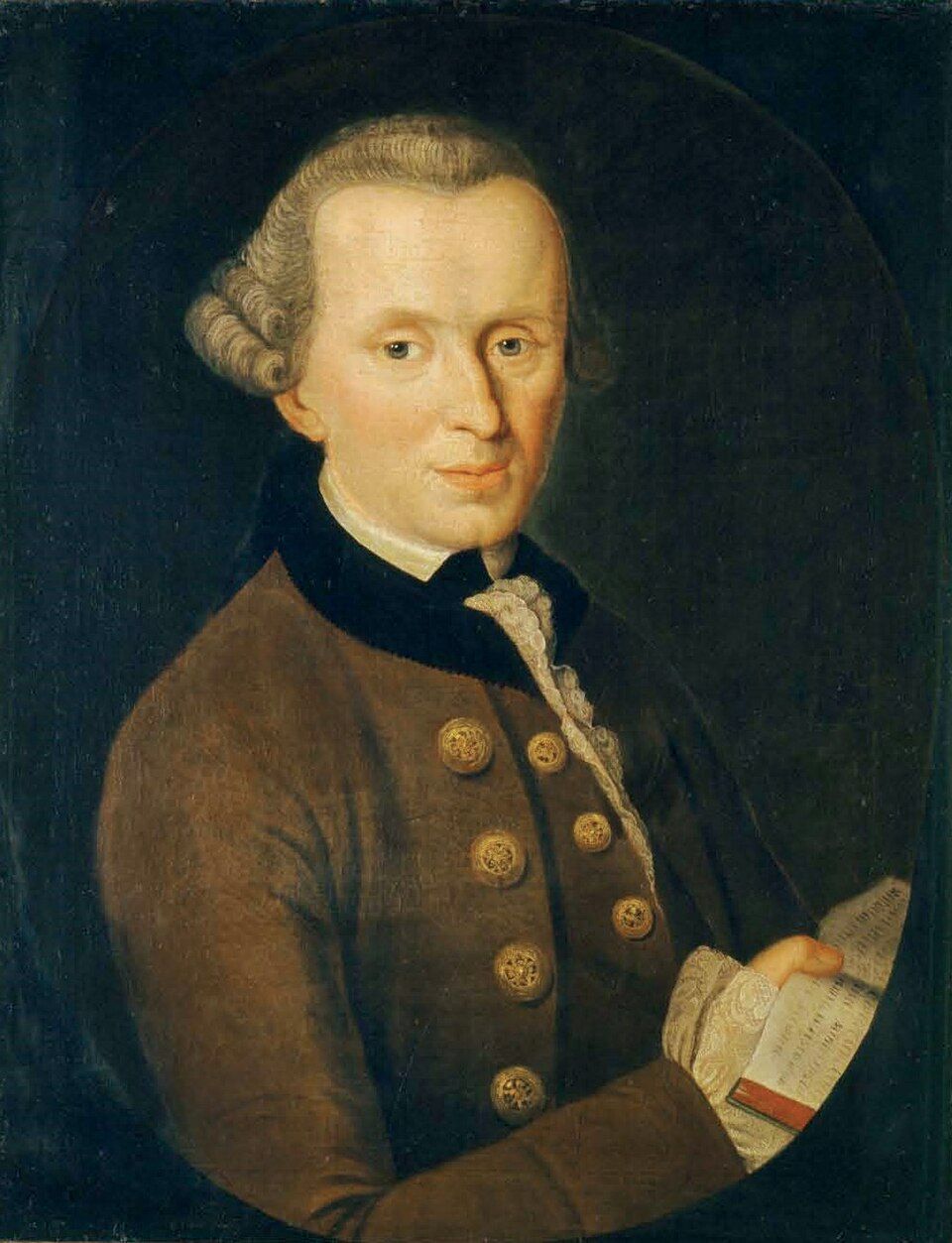
The view
Kant spent his whole life in and around Königsberg, in Prussia. His Critique of Pure Reason (1781; second edition 1787) asks what the mind contributes to knowledge. Its opening section, the Transcendental Aesthetic, gives his account of space and time.
Time, Kant argues, is not a concept drawn from experience, nor a property of things as they are in themselves. It is a pure form of intuition: the form of inner sense, the way in which everything we experience is ordered. Space is the form of outer sense; time is the form of all experience whatever.
Time is nothing but the form of inner sense. Kant, Critique of Pure Reason, A33/B49, our translation
That makes time, in Kant's terms, empirically real: everything we could ever meet in experience is genuinely in time. But it is transcendentally ideal: apart from minds like ours, it is nothing.
The argument
Time comes first. We cannot represent any event except as in time, but we can represent time empty of events. So time is not abstracted from events; it is presupposed by them.
The first antinomy. Later in the Critique, Kant shows what happens when reason applies such forms to the world as a whole. It can prove that the world had a beginning in time: otherwise an infinite series of states would already have been completed, and an infinite series can never be completed. It can equally prove the opposite: if the world began, it was preceded by empty time, and in empty time nothing could come to be, since no moment of it differs from any other.
The way out. Both proofs assume the world is a thing in itself, sitting in a time that is independent of us. Drop that assumption, recognise time as the form of our experience, and the contradiction dissolves. The question of the world's beginning has no answer either way.
Where he meets Deutsch
Kant and Deutsch diagnose the question "what came before the world?" in the same way: it rests on a false picture of time. For Kant, the picture is of time as a container independent of us. For Deutsch, it is of time flowing, so that it could start up or stop. The antithesis's argument about empty time before the world is exactly the kind Deutsch dismisses: the multiverse does not come into existence, because coming into existence presupposes the flow of time.
Both also agree that a great deal of our ordinary picture of time is supplied by us, not read off the world.
Where they part
Is time real? For Kant, time is real only as the form of our experience. For Deutsch, time is physical: the structure of relations between snapshots, which exists whether or not anyone experiences it.
Knowledge. Kant held that some knowledge, including the geometry of space and the structure of time, is known a priori and with certainty. Deutsch, following Karl Popper, holds that all knowledge is conjectural, and relativity and quantum theory have shown how much of the "certain" structure of time was wrong.
Things in themselves. Kant says we cannot know the world as it is in itself. Deutsch thinks our best explanations tell us what the world is really like, multiverse and all.
| Kant | Deutsch | |
|---|---|---|
| Does time flow? | Experience is always successive; time itself is a form, not a thing. | No. The idea is incoherent. |
| What is time? | The form of inner sense. | A physical structure of snapshots. |
| Did the world begin? | The question has no answer. | The question presupposes flow. |
| How do we know? | Partly a priori, with certainty. | By conjecture and criticism. |
Further reading
- Immanuel Kant, Critique of Pure Reason, translated by Paul Guyer and Allen W. Wood (Cambridge, 1998): the Transcendental Aesthetic and the first antinomy.
- Sebastian Gardner, Kant and the Critique of Pure Reason (London, 1999): a clear guide.
- Kant's Views on Space and Time, Stanford Encyclopedia of Philosophy.