Leipzig and Hanover, 1646–1716
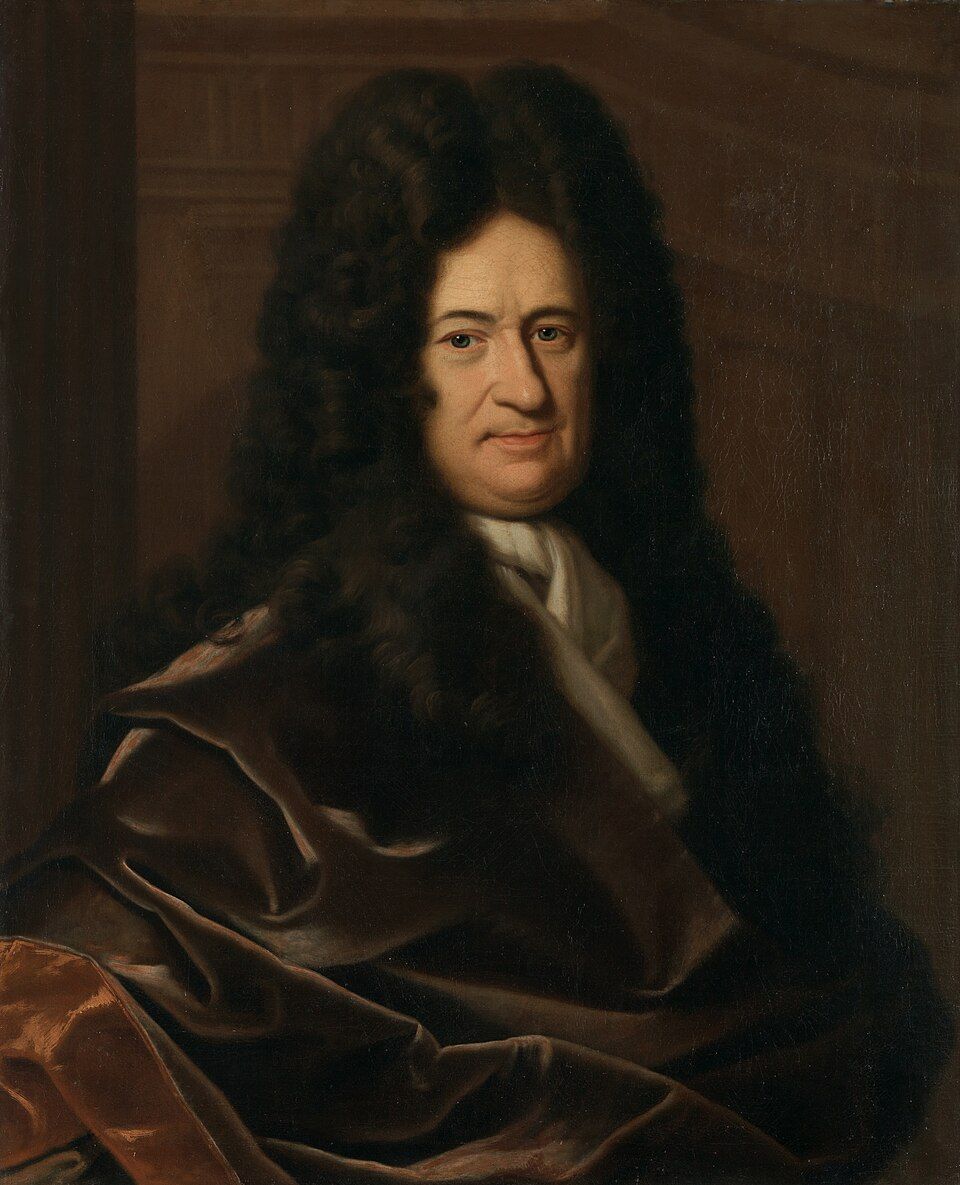
Gottfried Wilhelm Leibniz
Time is not a thing that events happen in. It is the order in which they happen. Take away the events and nothing is left, and a world created a year earlier would be no different at all.
The view
Leibniz was a philosopher, mathematician, diplomat and librarian, who invented the calculus independently of Newton. In the last years of his life he argued about space and time with Samuel Clarke, who defended Newton's views. Their letters, written in 1715 and 1716 and published by Clarke after Leibniz's death, remain the classic statement of the debate between absolute and relational time.
Space is an order of coexistences, as time is an order of successions. after Leibniz, third letter to Clarke (1716)
The argument
Sufficient reason. Leibniz held that nothing happens without a reason why it is so and not otherwise. Suppose time were absolute, as Newton said. Then God could have created the world a year earlier, with everything else the same. But there could be no reason for choosing one moment rather than the other, since every moment of empty absolute time is exactly like every other. So the supposition is impossible.
The identity of indiscernibles. Worse, the two supposed worlds would differ in no respect anyone could ever detect. Every event would stand in the same relations to every other. For Leibniz, two things that do not differ in any way are one and the same. The "earlier" world is just this world, described twice.
So time is relational. Time is nothing over and above the order of events: what comes before, what after, and by how much. Without things, there is no time.
Clarke's replies, and Newton's behind them, argued that motion needs an absolute frame. The question was not settled in Leibniz's lifetime; relativity and its successors have reopened it.
Where he meets Deutsch
On this question Deutsch is a Leibnizian. His thought experiment of shuffling spacetime's snapshots makes the same move as Leibniz's shifted world. The inhabitants could never tell the difference, because every record and relation lies inside the snapshots. There is no framework of time outside physical reality: each snapshot carries its own "time stamp" in its contents.
Both also treat the laws as what binds the moments together. For Leibniz, each state of the world follows from the one before according to God's plan; for Deutsch, the laws of physics are the only glue.
Where they part
Possible worlds. Leibniz held that God surveyed infinitely many possible worlds and created the best. The others remain merely possible. In Deutsch's multiverse, the variants are real: there really are universes in which events went otherwise, in definite proportions. That is what lets Deutsch give counterfactuals a meaning.
Monads and matter. Leibniz's ultimate reality is made of monads, simple mind-like substances. Deutsch's is physical.
Flow. Leibniz did not deny that things change or that the present moves; his concern was what time is, not whether it passes. Deutsch denies the flow outright.
| Leibniz | Deutsch | |
|---|---|---|
| Does time flow? | Not his question; time is the order of change. | No. The idea is incoherent. |
| Is time absolute? | No: it is the order of successions. | No: it is read off the snapshots. |
| Could the world be shifted in time? | No: nothing would differ. | No: shuffled snapshots are physically the same. |
| Other possible worlds? | Merely possible; this is the best. | Real, in definite proportions. |
Further reading
- H. G. Alexander (ed.), The Leibniz–Clarke Correspondence (Manchester, 1956).
- Julian Barbour, The Discovery of Dynamics (Oxford, 2001): the absolute–relational debate from a physicist's side.
- Leibniz's Philosophy of Physics, Stanford Encyclopedia of Philosophy.