Woolsthorpe, Cambridge and London, 1642–1727
Isaac Newton
Behind the clocks and the calendar runs a true time, absolute and uniform, that would go on flowing if the universe were empty. Every motion takes place in it, and no motion defines it.
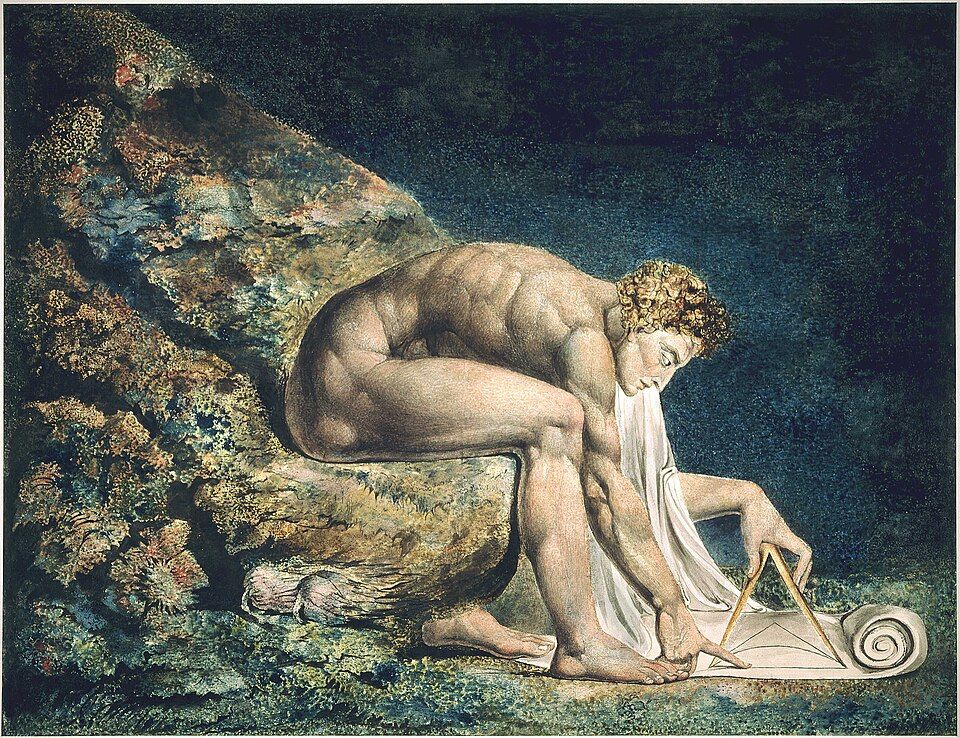
The view
Newton's Mathematical Principles of Natural Philosophy, the Principia (1687), set out his laws of motion and of universal gravitation. Before the laws, a short passage, the Scholium to the Definitions, says what he means by time, space and motion.
Absolute, true and mathematical time, of itself and from its own nature, flows equably without relation to anything external. Newton, Principia (1687), Scholium, our translation
This absolute time, also called duration, is distinguished from relative or common time: the measures of it we get from motion, such as an hour, a day, a month or a year. The measures are imperfect. Natural days, Newton notes, are not truly equal, which is why astronomers correct them by the equation of time. True time is what the corrections aim at.
The argument
The laws need it. Newton's first law says a body moves uniformly unless acted on. Uniformly by what standard? Only an absolute time makes "equal distances in equal times" meaningful independently of any particular clock.
Clocks can be wrong. We can say that the Sun's days are unequal, or that a pendulum runs slow. That only makes sense if there is something they are unequal or slow compared with. Absolute time is that standard.
It is independent of everything. Time does not depend on what happens in it. The order of times, like the order of places, is fixed, and things are located in it.
Newton's view was challenged at once. In his correspondence with Newton's ally Samuel Clarke, Leibniz argued that time is nothing but the order of events.
Where he meets Deutsch
Deutsch is generous to Newton. Time in the Principia, he says, is simply the common-sense time of clocks and calendars, given a precise role. And in Newtonian physics, time and motion already look like Deutsch's spacetime picture: a sequence of moments, glued together by deterministic laws that fix every state from any other.
The word "equably" has real content: Newton held that measurements of time agree for all observers, wherever they are and however they move. That is a substantive claim, and since Einstein we know it is not exactly true.
Where they part
"Flows." Deutsch's point is that Newton never put the flow into his physics. None of his laws refers to it, and no physical theory since has been compatible with it. Newton, Deutsch suggests, used the familiar language of time the way he might speak of the Sun rising, without meaning it literally.
Absolute or relational. Newton's time exists independently of everything in it. Deutsch's time is read off the snapshots themselves: each carries its own "time stamp", and there is no time outside physical reality against which they could be ordered. On this question Deutsch is with Leibniz.
One time for all. Newton's time is the same everywhere. Relativity replaced it with spacetime, in which observers slice moments differently, and Deutsch builds on that.
| Newton | Deutsch | |
|---|---|---|
| Does time flow? | Yes, equably, of its own nature. | No. The idea is incoherent. |
| Is time absolute? | Yes: independent of everything in it. | No: read off the snapshots themselves. |
| Do all observers agree on time? | Yes. | No; relativity shows they slice it differently. |
| Does the flow appear in the physics? | No: none of his laws uses it. | No: and none ever has. |
Further reading
- Isaac Newton, The Principia, translated by I. Bernard Cohen and Anne Whitman (Berkeley, 1999): see the Scholium to the Definitions.
- H. G. Alexander (ed.), The Leibniz–Clarke Correspondence (Manchester, 1956).
- Newton's Views on Space, Time, and Motion, Stanford Encyclopedia of Philosophy.