Thagaste and Hippo, 354–430
Augustine
What then is time? If no one asks me, I know. Try to explain it and I do not. Augustine's answer is that the past and the future exist only in the mind, as memory and expectation, and that time is a stretching of the soul.
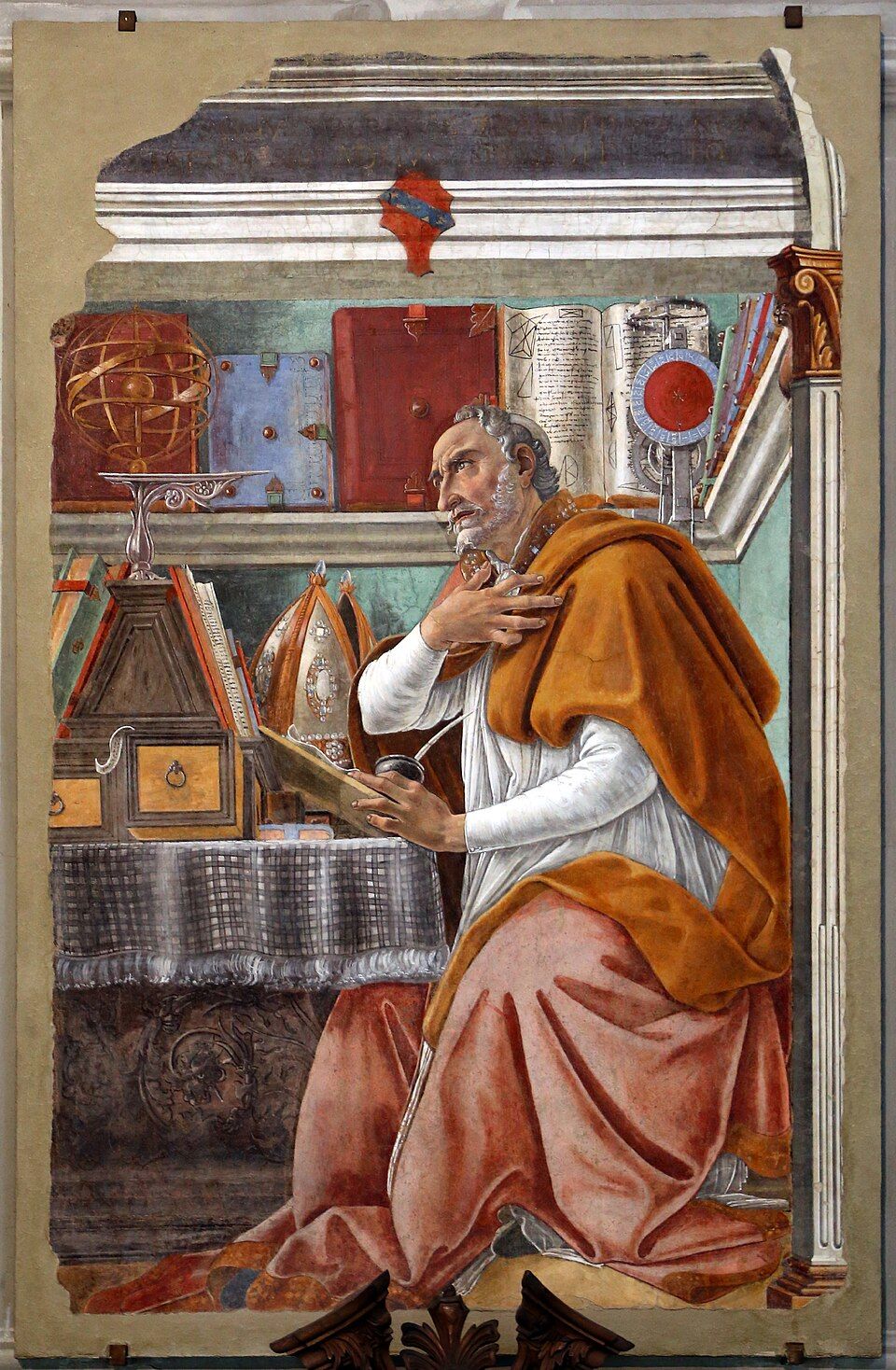
The view
Augustine was born in Thagaste in North Africa, taught rhetoric in Carthage, Rome and Milan, and spent his last decades as bishop of Hippo. Book 11 of his Confessions, written around the year 400, is the most famous meditation on time in Western philosophy. Deutsch opens his chapter with its most famous line.
What then is time? If no one asks me, I know. Augustine, Confessions 11.14, our translation
The puzzle that follows is simple to state. The past is no longer; the future is not yet. The present, if it stayed present, would not be time but eternity, and it is time only because it passes into the past. So time seems to exist only by tending towards non-existence. How then can we measure it, as we plainly do?
The argument
Three presents. Augustine's answer is that past and future exist, but only in the mind. There is a present of things past, which is memory; a present of things present, which is attention; and a present of things future, which is expectation (11.20).
Measuring in the mind. When we compare a long syllable with a short one, we do not measure the syllables themselves, which have gone. We measure something that stays fixed in memory. Time, Augustine concludes, is a distentio animi, a distension or stretching of the mind (11.26).
Reciting a psalm. His example: before I begin a psalm I know, all of it lies in expectation. As I recite, it passes through attention into memory, until expectation is used up and the whole is in memory. What holds for the psalm holds for a whole life, and for the whole history of humankind (11.28).
Nothing before creation. What was God doing before he made heaven and earth? Augustine refuses the joke answer, that he was preparing hell for people who ask such questions. The question has no answer because there was no "before". Time was made with the world, and God, who is eternal, is not in time at all (11.12–13).
The words in the figure are the opening lines of the hymn Deus creator omnium by Ambrose, Augustine's teacher in Milan, which Augustine himself uses in book 11 to measure long and short syllables.
Where he meets Deutsch
Deutsch begins with Augustine for a reason. Both think the ordinary concept of time is confused, and both locate our sense of past and future in the mind's present contents. For Deutsch, what we experience are differences between present perceptions and present memories. For Augustine, the past is present to us only as memory. A snapshot of a reciter, in Deutsch's terms, holds exactly Augustine's three presents.
And both dissolve the question of what came before the beginning. For Augustine there is no "then" before time. For Deutsch, asking what happened before the Big Bang only makes sense if we imagine time flowing, and it does not.
Where they part
Do past and future exist? For Augustine, past and future exist only as memory and expectation; strictly, only the present is. That leans towards presentism. For Deutsch every moment is physically real, and the view that only our own moment is real is a kind of solipsism.
Mind or world. Augustine makes time a feature of the mind. Deutsch makes it a feature of the physical world, the relations between snapshots fixed by law, which minds then perceive.
Eternity. Augustine contrasts time with God's eternity, outside time altogether. Deutsch has no realm outside the multiverse: it contains all the space and time there is.
| Augustine | Deutsch | |
|---|---|---|
| Does time flow? | It passes: future through present into past. | No. The idea is incoherent. |
| Where are past and future? | In the mind, as memory and expectation. | Real snapshots, elsewhere in the multiverse. |
| What came before the world? | Nothing: time was made with it. | The question presupposes the flow of time. |
| Anything outside time? | God's eternity. | Nothing outside the multiverse. |
Further reading
- Augustine, Confessions, book 11. Henry Chadwick's translation (Oxford, 1991) is clear and well annotated.
- Richard Sorabji, Time, Creation and the Continuum (London, 1983), chapter 2.
- Saint Augustine, Stanford Encyclopedia of Philosophy.