Athens, c. 428–348 BC
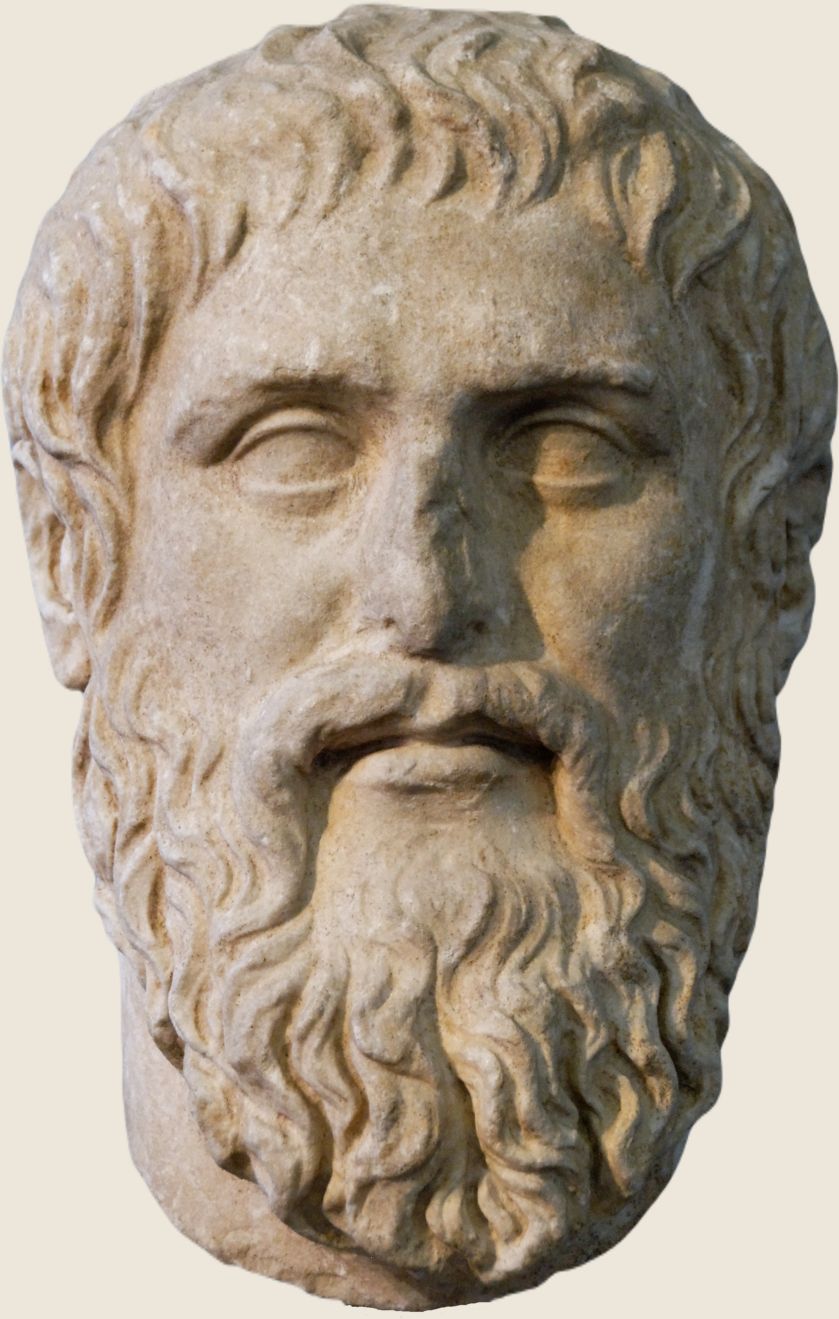
Plato
What truly is never changes, and so it has no past or future. Time is a made thing: a moving image of that stillness, switched on together with the heavens, and measured by their turning.
The view
Plato's account of time comes in the Timaeus, a dialogue in which the character Timaeus tells how a divine craftsman, the Demiurge, built the cosmos. The craftsman looked to an eternal model, a living thing that never changes, and tried to make the world as like it as it could be. But a world of bodies cannot be eternal in the way the model is. So, Timaeus says, the craftsman resolved to make something that moves while eternity stays at rest.
He resolved to make a moving image of eternity. Plato, Timaeus 37d
That image is time. It runs "according to number", and the Sun, Moon and five planets were made to mark and guard its numbers (38c–39e). The turning of the heavens gives us days, months and years, and these are the parts of time.
The argument
Being does not change. What is always the same, the model, cannot become older or younger, and so has no past and no future. Plato takes a line from Parmenides here, but applies it only to the eternal. The world of becoming is real enough to be worth studying, though lesser.
"Was" and "will be" belong to the image. Timaeus says that these tenses are forms of time that came to be, and that we carry them over by mistake to eternal being, of which only "is" is true (37e–38a). It is a short step from Parmenides' "it is now, all together".
Time begins with the heavens. There were no days, nights, months or years before the heavens came to be (37e). Time and the cosmos were made together, so that, as Timaeus puts it, if they are ever dissolved, they will be dissolved together (38b).
Time is counted by motion. The planets are called "instruments of time". When their circuits are all complete together, a perfect number of time is complete, the "Great Year" (39d). Aristotle will keep the link between time and counted motion and drop the craftsman.
Ancient readers disagreed about whether the creation is meant literally. Aristotle took it that way and argued against it. Some Platonists, from Speusippus and Xenocrates on, read it as a teaching device that separates the ingredients of the world so we can see them one by one. That debate has not ended.
Where he meets Deutsch
Plato and Deutsch agree that time is not a container that was already there when the world began. For Plato, time is made along with the heavens. For Deutsch, asking what happened before the Big Bang assumes that time flows into the universe from outside, and there is no outside. The multiverse contains all the space and time there is. In both pictures, "before the beginning" is a question with a false premise.
Plato also thinks the tensed words, "was" and "will be", mislead when applied to the whole of what is real. Deutsch says something close: talk of the "flow" of time carries a hidden picture, and when physics is stated properly, the picture goes.
There is a looser echo too. Plato's planets are clocks, bodies whose regular motion lets us number time. Deutsch's snapshots each carry a "time stamp", the reading on some natural clock inside the universe. In neither case does time rest on anything beyond the world's own changes.
Where they part
Two levels of reality. Plato divides what truly is, eternal and unchanging, from what only becomes. Time belongs to the lower level and is a copy of the higher. Deutsch has no such ranking: every moment, in every universe, is as real as any other.
A maker with a purpose. The Demiurge builds time to make the world resemble its model as far as possible. Deutsch's multiverse is not made by anyone. The laws of physics are the glue that holds its snapshots together.
One cosmos. Plato's world is a single living whole, with the heavens turning in an orderly cycle. Deutsch's reality is a vast collection of snapshots, with no single line through them, and the regular cycles of the sky are a feature of our corner of it.
A moving image. Plato's time still moves, however much it is an image. The heavens turn, and time runs by number. Deutsch denies that anything moves along the snapshots at all.
| Plato | Deutsch | |
|---|---|---|
| Does time flow? | Yes, as an image: it moves by number while eternity stays still. | No. The idea is incoherent. |
| Where did time come from? | Made with the heavens by the Demiurge. | Not made. There is no framework of time outside reality. |
| Is there a timeless realm? | Yes, and it is more real than time. | No ranking: all moments are equally real. |
| What measures time? | The circuits of the heavenly bodies. | Natural clocks inside each snapshot. |
Further reading
- Plato, Timaeus, 27d–47e, on the making of the cosmos and of time. Donald Zeyl's translation (Hackett, 2000) is a good place to start.
- F. M. Cornford, Plato's Cosmology (London, 1937): translation and line-by-line commentary on the Timaeus.
- Richard Sorabji, Time, Creation and the Continuum (London, 1983), part 1, on whether the creation is literal.
- Plato's Timaeus, Stanford Encyclopedia of Philosophy.