Stagira and Athens, 384–322 BC
Aristotle
Time is not a thing and does not flow by itself. It is what we count when we count change: the number of motion in respect of before and after. Where nothing changes, there is nothing to number.
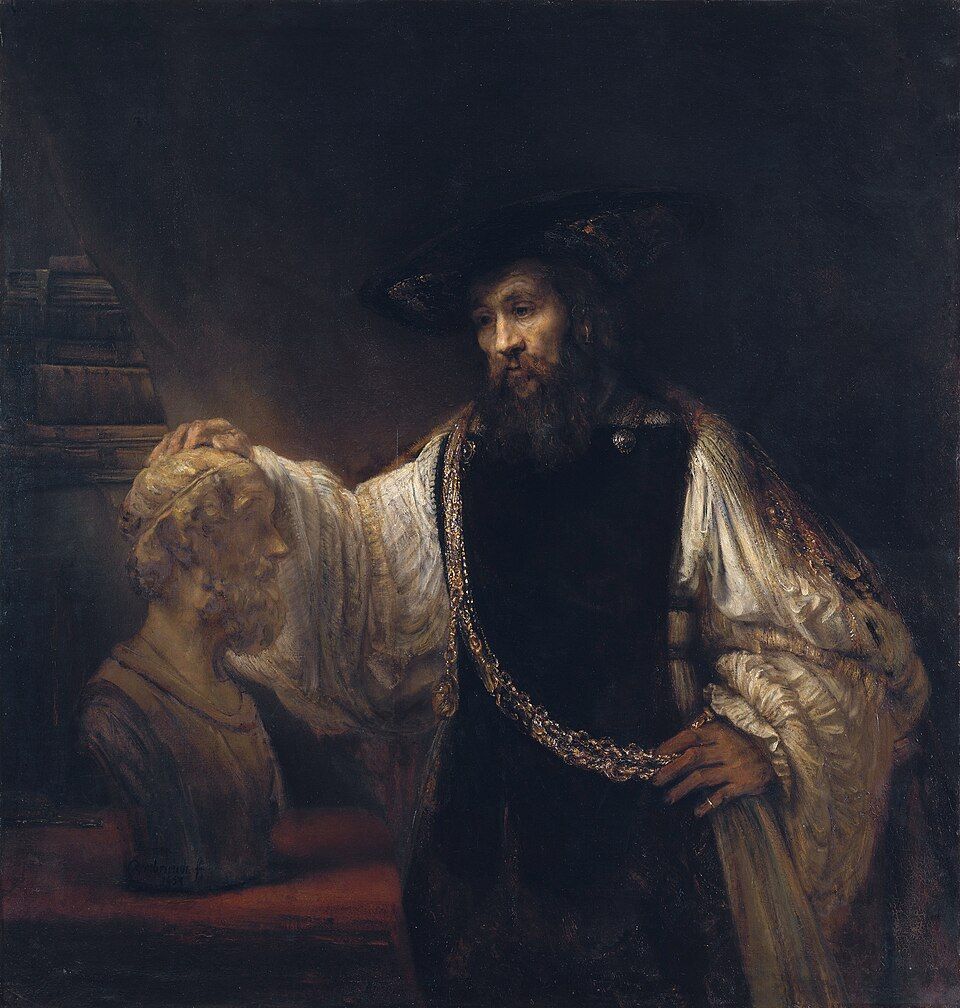
The view
Aristotle's discussion of time is a few chapters of the Physics (book 4, chapters 10–14). It is the first extended treatment in the Western tradition, and it sets the terms for much of what followed. He begins, as he often does, with puzzles. Time seems barely to exist. The past is no more and the future is not yet, and the present moment, the "now", is no part of time, since a part must be able to add up to the whole and a now has no length.
His way out is to say what time is relative to. It is not itself change, since change is here or there and fast or slow, and time is everywhere the same. But it does not exist apart from change either. We notice time precisely when we notice before and after in a change.
The argument
The definition arrives at Physics 219b1–2:
Time is the number of change in respect of before and after. Aristotle, Physics 219b1–2
No time without change. If our own thoughts stood still, as in a sleeper, we would not perceive any time passing. We sense time when we sense a before and an after.
Time is a number, but a counted number. Aristotle distinguishes what is counted from the number it is counted as: ten horses and ten dogs are different things with the same number. In the same way, time is the countable aspect of motion, the thing every clock measures, and not any particular motion.
The now is a boundary, not a part. The now divides past from future and joins them, as a point does on a line. Because it is continuous with the change it follows, time is continuous too, with no smallest interval. This is also how Aristotle answers Zeno: time is not made of nows, so adding up instants of rest was never the right sum.
A question about minds. To count, something must be able to count. Aristotle asks, without settling it, whether time would exist if there were no soul to number change (223a21–29). It is one of the places where later philosophers have most wanted to press him.
In book 8 he argues that motion and time have no beginning and no end: there was never a first change, since any first change would itself need something earlier to bring it about.
Where he meets Deutsch
Aristotle is no friend of an absolute time that runs by itself, whatever Newton would later say. For him time is defined by what happens in it, and it makes no sense without change. That is close to the spirit of Deutsch's claim that time is not an extra ingredient running through the world, but something read off from how states of the world differ and relate.
Aristotle's refusal to treat the "now" as a part of time, with a reality of its own, also fits Deutsch's insistence that no moment is special.
The remark about the soul is a looser echo. Deutsch explains our sense of time by what observers record and remember in each snapshot, so the perceiving mind has work to do in both accounts. That is a likeness of structure rather than of doctrine.
Where they part
Passage. Aristotle's now, though a boundary, moves with the change it follows, and time runs from earlier to later. Deutsch holds that nothing moves along the snapshots at all.
One continuous time. Aristotle has a single, continuous, unbroken time, matched to the single cosmos. Deutsch has a multiverse of snapshots, where time is not one line but a set of relations among states. Aristotle's time never begins. Deutsch says the multiverse does not come into existence either, and that the ordering of snapshots into a sequence breaks down near the Big Bang.
Number versus structure. For Aristotle, time is a measure, a number. For Deutsch, the order of the snapshots comes from the laws of physics, and a count of change is a derived thing.
Zeno. Aristotle needs time and change to be continuous, with no smallest interval, to answer Zeno. Deutsch answers the arrow another way, by locating motion in the differences between snapshots rather than inside any one of them.
| Aristotle | Deutsch | |
|---|---|---|
| Does time flow? | Yes: the now follows change, earlier to later. | No. The idea is incoherent. |
| What is time? | The number of change in respect of before and after. | A relation between snapshots, not a thing. |
| Time without change? | No. Without change, nothing to number. | Time lies in differences between states. |
| One time or many? | A single continuous time for one cosmos. | A multiverse of snapshots, with no single line. |
Further reading
- Aristotle, Physics, book 4, chapters 10–14, and book 6, chapter 9, on Zeno. Joe Sachs and Robin Waterfield both have good translations.
- Ursula Coope, Time for Aristotle (Oxford, 2005): a close study of the definition.
- Richard Sorabji, Time, Creation and the Continuum (London, 1983), part 1.
- Aristotle's Physics, Stanford Encyclopedia of Philosophy.