Elea, born c. 490 BC
Zeno of Elea
Parmenides said that nothing moves. Zeno set out to show that those who say otherwise are in worse trouble. His arrow flies, and at every instant of its flight it is standing still.
The view
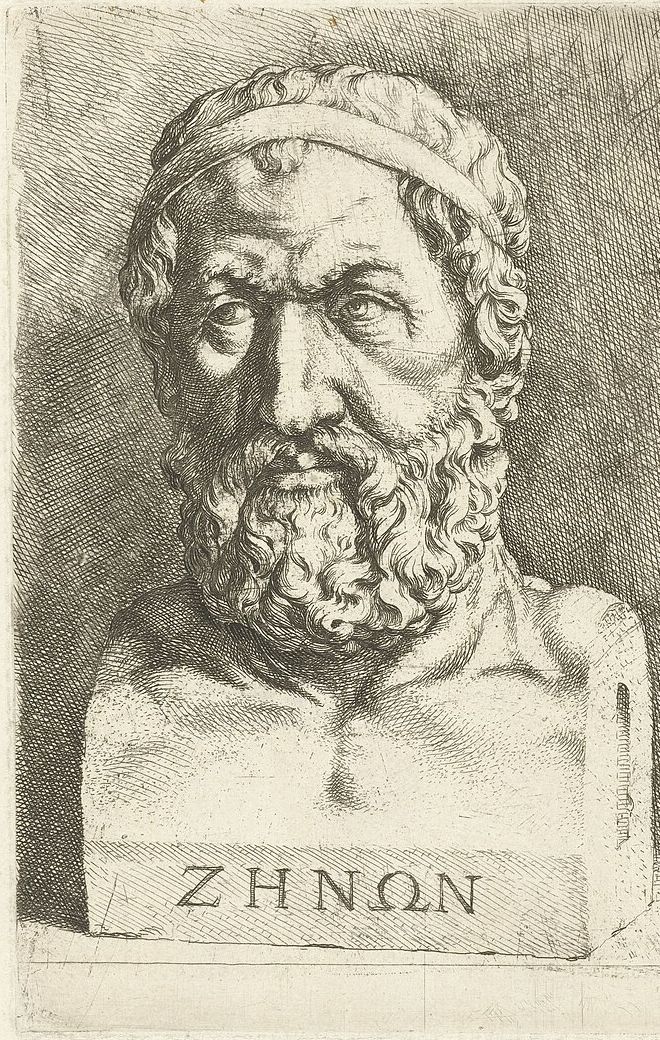
Zeno was Parmenides' younger friend and follower. Plato tells, in his dialogue Parmenides, how Zeno wrote a book in his youth, answering people who ridiculed his master's claim that all is one. If many things exist, Zeno argued, absurd consequences follow. The same went for motion. Zeno's own book is lost. We know his arguments mainly from Aristotle, who reports four against motion and tries to answer them, and from later commentators such as Simplicius.
The attack is a reductio. Zeno does not say what time is. He takes the ordinary picture, in which things move through a time made of successive instants, and shows that it contradicts itself. Two of the four paradoxes, the Dichotomy and Achilles, turn on endless division of the path. The Arrow turns on the instant itself, which is why it matters most here.
The argument
Aristotle reports it in the Physics (6.9; Diels–Kranz 29 A27), and in his version it runs briefly. Our paraphrase, in four steps:
Whatever fills a space its own size is at rest; the arrow always does. after Aristotle, Physics 239b5–7 (A27)
At any instant, the arrow occupies a region of space exactly its own size. It has not got room to be anywhere else, and it cannot be half in one place and half in another.
Something that occupies exactly its own region is at rest. To move is to be in one place at one time and another place at another time. An instant has no duration, so it holds only one place.
Time is made of instants. The whole flight is nothing but the instants that make it up.
So the arrow is at rest at every instant, and therefore throughout. Add up any number of states of rest and you never get motion.
Aristotle's reply was to reject the third step: time is not composed of indivisible nows, any more than a line is composed of points. The standard modern reply keeps the instants but changes what motion is. Following Bertrand Russell, motion is just being at different places at different times, with no further "motion" hidden inside any single instant. Velocity is then defined by how position changes over shrinking intervals, which is what calculus makes precise. Whether this removes the paradox or merely relabels it is still argued over; many philosophers think it settles the mathematics and leaves a residue about passage.
Where he meets Deutsch
Zeno's central observation is one Deutsch can accept. A single instant contains no motion. Take one snapshot of the world and the arrow is just somewhere, in a particular place with a particular orientation. Deutsch's snapshots work the same way: whatever is moving, each snapshot is a still state, and the motion shows only in how snapshots differ.
Both men also go after the same target, the picture of a present that moves along a line of instants, and both think that picture falls apart under scrutiny. Zeno and Deutsch agree that the flow of time cannot simply be assumed. They differ on what to do next.
Where they part
Is motion real? For Zeno's purposes, no: the argument is meant to show that the ordinary notion of motion is incoherent, and Parmenides' still universe is what remains. For Deutsch, motion is real. It is the difference between snapshots, and the rotating arrow does point in different directions in different ones.
What follows from the instant. Zeno goes from "no motion in an instant" to "no motion at all", because for him time is a succession of instants. Deutsch denies that the snapshots form a succession in which anything has to travel from one to the next. What links them is physical law, not passage, so the step from instant to flight never comes up.
Purpose. Zeno is a defender, using paradox to guard Parmenides. Deutsch is building a positive account, one he thinks the best physics supports. The arrow is a puzzle for Zeno and a worked example for Deutsch.
One or many. Zeno's other argument family attacks plurality too, and for the same reason: unity is all he will allow. Deutsch's reality is a vast multiplicity.
| Zeno | Deutsch | |
|---|---|---|
| Does time flow? | The ordinary idea of flow through instants leads to absurdity. | No. The idea is incoherent. |
| Is motion real? | Not as ordinarily conceived. | Yes, as differences between snapshots. |
| What is an instant? | A durationless slice in which nothing moves. | A snapshot, a real physical state, in which nothing moves. |
| What is the argument for? | Defending Parmenides' unmoving reality. | Building a positive account from physics. |
Further reading
- Wesley C. Salmon (ed.), Zeno's Paradoxes (Indianapolis, 1970): the classic collection, with Russell, Black and Grünbaum.
- G. S. Kirk, J. E. Raven and M. Schofield, The Presocratic Philosophers, 2nd edn (Cambridge, 1983), chapter 10.
- Nick Huggett, Everywhere and Everywhen (Oxford, 2010), on Zeno and modern physics.
- Zeno's Paradoxes, Stanford Encyclopedia of Philosophy.