Elea, c. 515 – after 450 BC
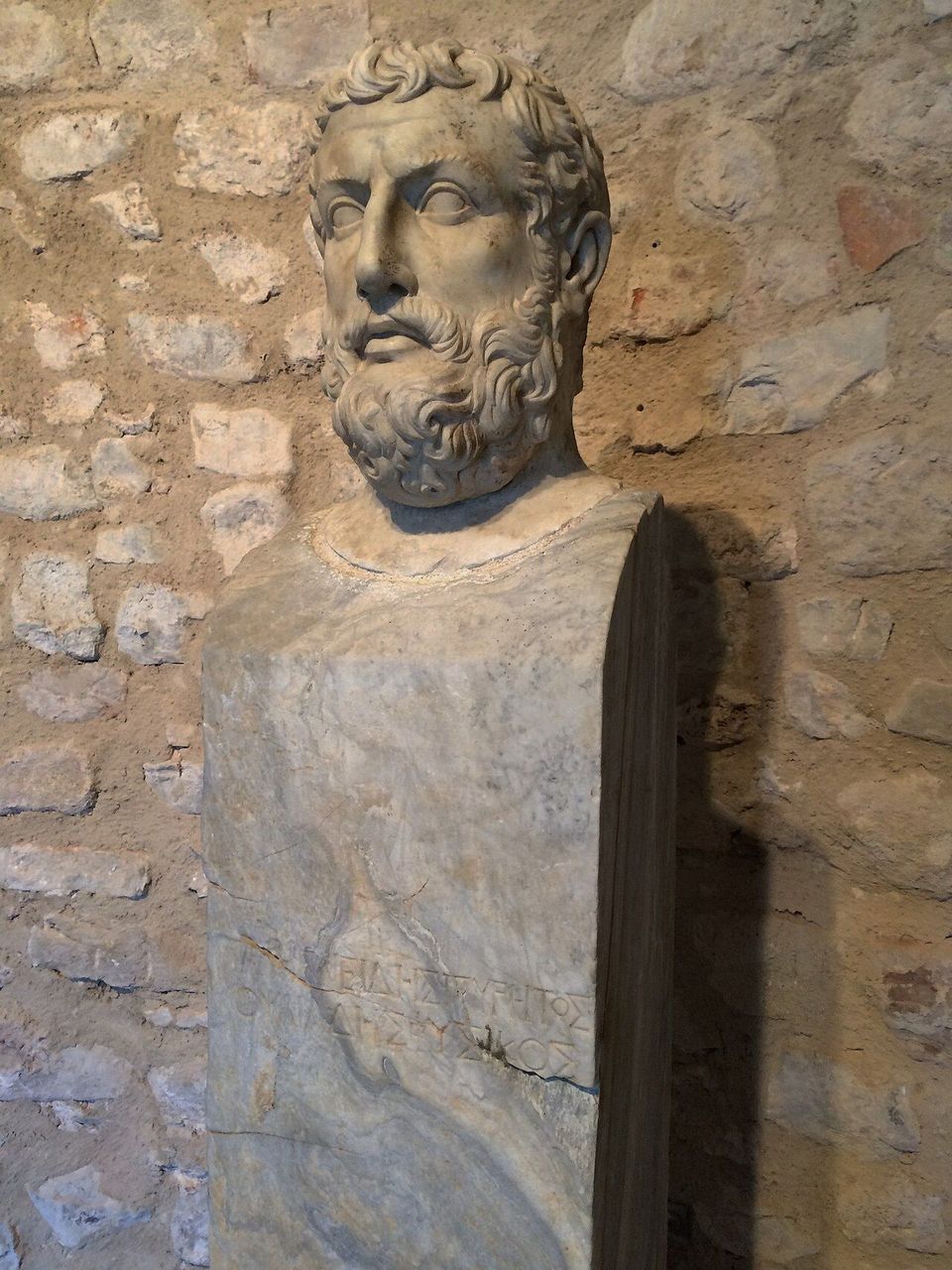
Parmenides
Nothing can come from nothing, and nothing can become nothing. So nothing ever begins, ends or changes. Reality is one, whole and unmoving, and the world of change is a story mortals tell themselves.
The view
Parmenides set out his philosophy as a poem in epic verse. About a hundred and sixty lines survive, most of them because the scholar Simplicius copied them out a thousand years later, worried that the book was becoming rare. In the opening, a young man is carried by chariot, escorted by the daughters of the Sun, through the gates of Night and Day to meet a goddess. She offers him two accounts: the Way of Truth, and the Way of Opinion, the beliefs of mortals, in which there is no true reliance.
The Way of Truth starts from a single choice. Either something is, or it is not. The second road cannot even be travelled, because what is not cannot be thought or spoken of:
For the same thing is there to be thought and to be. B3
From that one premise the goddess draws everything else, in what may be the first sustained deductive argument in Western thought.
The argument
What is cannot come to be. Out of what? Not out of what is not, since there is no such thing. And there is a second problem: if it came to be, why then rather than earlier or later? Nothing could have prompted it at one moment rather than another. The same arguments rule out perishing.
So it has no past and no future. The goddess draws the conclusion in a line that has fascinated readers ever since:
Nor was it ever, nor will it be, since it is now, all together, one, continuous. B8.5–6
It is undivided and unmoving. There is no "more" or "less" of being anywhere to split it into parts, and nothing else for it to move into. It is complete, held fast in its limits, like the mass of a well-rounded sphere (B8.43).
Change, motion, birth, death and plurality therefore belong to the Way of Opinion. The goddess goes on to teach that too, a full cosmology of Light and Night, so that no mortal view will outstrip the young man's. But she is clear that it is not true.
His followers took the fight to the critics. His pupil Zeno of Elea built his paradoxes of motion, Achilles and the tortoise and the flying arrow, to show that believers in change face absurdities at least as bad as the ones they mocked in Parmenides.
Where he meets Deutsch
Parmenides is the oldest ancestor of the block universe. Look at spacetime as Deutsch describes it in figure 11.5: everything that ever happens laid out once and for all, frozen, with nothing in it coming to be or passing away. That is Parmenides' sphere in four dimensions.
The echoes go further. Ask what happened before the Big Bang, and Deutsch answers that the multiverse does not come into existence or cease to exist; the question only arises if we imagine time starting up. Parmenides' argument is the same in outline. Nothing can begin, because a beginning needs a "before" and a reason for "then rather than sooner", and there is neither.
And both men treat the common-sense experience of passage as an error to be explained, not a datum to be respected. For Parmenides it is mortal opinion. For Deutsch it is a misreading of the differences between our perceptions and our memories.
Where they part
One or many. Parmenides' reality is a single undivided whole. Deutsch's is the opposite extreme: an unimaginable number of snapshots, each distinct, most of them in other universes. Nothing flows, but there is a great deal of difference.
Is change real? For Parmenides, no. For Deutsch, yes, though not as a flow: change is real difference between snapshots that are related by law. The rotating arrow really does point down in one snapshot and up in another. A Parmenidean has to call that opinion too.
What is not. Parmenides forbade all talk of what is not. Deutsch shows why our talk of what is not, "if Faraday had died in 1830", has always made sense: it was never about nothing. It refers to snapshots that really exist, elsewhere in the multiverse. What is not here is somewhere.
"It is now." On one reading, Parmenides' being exists in a single, everlasting present. If so, he kept the one thing Deutsch most wants to abolish, a privileged now. Other scholars read the line as timeless, with being outside time altogether; the dispute is still open.
Reason and the senses. Parmenides reached his conclusion by pure argument and told us to distrust our eyes. Deutsch, a follower of Karl Popper, holds that knowledge grows by bold explanations criticised and tested against observation. His case against the flow of time rests partly on logic, as figure 11.3 shows, but its positive picture comes from the best-tested theories in physics: relativity and quantum mechanics.
| Parmenides | Deutsch | |
|---|---|---|
| Does time flow? | No. Nothing comes to be or passes away. | No. The idea is incoherent. |
| Is change real? | No. It belongs to mortal opinion. | Yes, as differences between snapshots. |
| One or many? | One undivided whole. | Vastly many snapshots and universes. |
| How do we know? | Pure reason; distrust the senses. | Explanation, criticism and experiment. |
Further reading
- David Gallop, Parmenides of Elea: Fragments (Toronto, 1984): Greek text with a clear translation.
- G. S. Kirk, J. E. Raven and M. Schofield, The Presocratic Philosophers, 2nd edn (Cambridge, 1983), chapter 8.
- Patricia Curd, The Legacy of Parmenides (Princeton, 1998): a reading of what "is" means in the poem.
- Jo Marchant, In Search of Now: The Science of the Present Moment (New York, 2026), which opens with Parmenides against Heraclitus.
- Parmenides, Stanford Encyclopedia of Philosophy.